The following is a Press release by the Choiseul Constituency Branch.
"During the public meeting held by the St. Lucia Labour Party in the Choiseul village on Wednesday October 26, 2011, Harold Dalson, the MP for Soufriere/Fond St.Jacques urged the people of Choiseul/Saltibus to accost Rufus bousquet, the MP for Choiseul/Saltibus push their hands into Bousquet's pockets and take their money from him.
Mr. Dalson was referring to the Taiwanese Funds which he alleged was being misappropriated by the UWP Gov't MP.
We are literally astonished by the irresponsible nature of Mr. Dalson's palpably putrid statement.
This statement by Mr. Dalson is dreadful, inappropriate, slanderous and insulting to the people of Choiseul/Saltibus, Soufriere,The labour Party and t St. Lucia.
Is it that Mr. Dalson is desperate in his attempt to win this election that he feels he must resort to the lowest levels possible to exact his objectives.
Is it Mr. Dalson's intention to provoke criminality during this election campaign?
The Choiseul/Saltibus Constituency Branch demands a retraction of this contemptible statement and an apology to the people of St.Lucia.
Source: Uwp Constituency Branch
Friday, October 28, 2011
Wednesday, October 26, 2011
UWP - Better at handling the ECONOMY
Last night the PM addressed the nation on one of such addresses to be held weekly. Last night's address focussed on the ECONOMY. We bring you this address unedited.
FIRST WEEKLY ADDRESS TO THE NATION
ON NATIONAL ISSUES AND PERSPECTIVES
(October 20, 2011)
By Honourable Stephenson King
Prime Minister and Minister for Finance, Economic Affairs and National Development
Fellow Saint Lucians, I am pleased to report, that, under the United Workers Party Administration, the Saint Lucia economy has weathered the stormy years of natural disasters and the global financial crisis and is now poised to achieve more robust growth and provide even greater opportunities for all.
A St Lucia Labour Party assessment on the World Wide Web highlights the widely known truth that these past few years have been the worst of times all around the world. In their assessment the SLP claim:
“We are operating amidst the backdrop of the most financially depressing period since the Great Depression of the 1930s. The effects were first felt by the industrialized world but shortly precipitated to our developing sphere before we even knew it.
“As a small open economy we are susceptible to the economic conditions prevailing around the world. This predicament is further exacerbated when the hardships are centered on our primary markets of the US & UK.
“The global financial meltdown has therefore created an environment that forces policy makers to act. Our leaders will not and cannot proffer all the solutions or fix all problems but policies must be formulated to safeguard the most vulnerable, while creating an environment enabling to economic activity”
I remind you, fellow Saint Lucians, that this is the official position of the St Lucia Labour Party. Yet the same St Lucia Labour Party is critical of the fact that in these difficult circumstances, Saint Lucia, like other countries around the world experienced economic decline, job losses and increased debt.Remarkably though, those who are only now recommending policies to “safeguard the most vulnerable while creating an environment enabling to economic activity”, do not have the strength of character to admit that your UWP government has been there, and it has done exactly that and much more. We formulated the policies, we delivered the social safety nets and we enabled increased economic activity against all odds.
However, while the Opposition steadfastly refuses to acknowledge our outstanding success in managing the economy, the international institutions and global community recognizes our efforts. The International Monetary Fund (IMF), in a press release issued in August of this year regarding the recently concluded Article IV Consultation on Saint Lucia, noted “Saint Lucia’s economy recovered rapidly from the global crisis, supported by timely policy action by the authorities and a rebound in construction and tourism”. My fellow Saint Lucians, what better endorsement can any government receive at a time when most countries around the world, including the Caribbean, are still struggling to recover from the global economic crisis?
It has not been an easy road for the Government and people of Saint Lucia, but through caring, visionary, competent leadership, the UWP has improved the country’s economic management performance and thereby strengthened the country’s position as the leading economy in the OECS.
In the last two years as a result of the effectiveness of your Government’s response to the global economic crisis, Saint Lucia moved from its long-standing second position to surpass Antigua and Barbuda as the largest economy in the OECS.
When we came into office at the end of 2006 we met:
• Average economic growth of 1.6% over the previous 5 years
• An unemployment rate of 16.6%
• A national debt of 1.6 billion EC dollars (approximately 64% of GDP)
These numbers from the Government’s Statistics Department and the Eastern Caribbean Central Bank are extremely important in setting the record straight about economic activity in Saint Lucia since 1997.
In the six years of the decade ending 2010 when the world economy was buoyant and when the St Lucia Labour Party was in power, it was only able to achieve an average economic growth rate of 1.6% per year. In 3 of those 6 years, while the global economy blossomed and the Dow Jones indicator of wealth creation was cruising above 15 thousand, the St Lucia Labour Party came up with negative growth. In other words, the St Lucia Labour Party sent Saint Lucia into reverse gear 3 out of 6 times (50%) in the six years of the decade when the economy was doing well.
Today, the SLP criticizes an average growth rate of 2.6% per year since 2007 under my leadership in the near impossible circumstances of a global financial crisis, the ravages of Hurricane Tomas and with the Dow struggling to keep its head above the eleven thousand mark.
The Saint Lucia economy grew by 4.4% in 2010 and the rate of inflation was 1.9%. This was by far the best performance in the Eastern Caribbean Currency Union where member nations registered an overall economic decline of 2.7% and an inflation rate of 2.9%. The response of the SLP to this impressive performance is the cynical statement that nationals are not feeling the growth.
Nonetheless, once again in 2010 which is the latest year for which we have data, key indicators of economic activity continued to point relentlessly in the upward direction for the benefit of nationals from all walks of life:
• Tourism revenue – up 33.7%
• Construction - up 20.5%
• Airline activity at Hewanorra - up 26.5%
• Vehicle registrations - up 4.8%
• Electricity consumption – up 4.8%
• Commercial Sector – up 4.9%
• Hotel Sector – up 7%
The UWP believes that these results as documented in the official statistics bear eloquent testimony to the resilience and effectiveness of its stewardship through environmental disasters in an uncertain global economic environment.
While much is made of unemployment numbers, official Government Statistics confirm that the 2006 unemployment figure of 16.6% was the best achieved in two consecutive terms under the St Lucia Labour Party during which the average annual unemployment rate was 19.2%. The UWP on the other hand, drove the average annual unemployment rate down to 17.1% since it assumed office in 2006.
While we acknowledge a reduction in employment opportunities as a casualty of these challenging times, no other government has done a better job of providing more jobs for more people. We did it in the toughest of times and we will continue to do it. There was no need for any clumsy STEP and no need for any blind LEAP either. All we relied on was the basic common sense that jobs are created by the increased consumption of goods and services and sound investment in an economy on the move.
In 2006, the SLP left behind a national debt of 1.6 billion EC dollars (approximately 64% of GDP). In the five years prior, the debt stock grew by 677 million under the SLP and in the last five years under the UWP it has increased by a further 532.1 million. There can be no question that debt financing was a more critical need to keep the economy afloat in the last five years of natural disasters at home and financial market disasters abroad. Side by side with the economic performance results, the debt comparison numbers allow an easy assessment of the superiority of UWP economic management talent and ability over that of the SLP.
Saint Lucia’s official debt at December 31, 2010 stood at approximately 2.0 billion EC dollars and the debt to GDP ratio of 64.8% is the second lowest in the Eastern Caribbean Currency Union. Let me repeat fellow Saint Lucians, that our current debt burden which is being criticized left right and centre by the political opposition is actually smaller than that of St Kitts, Grenada, Antigua and Barbuda, and Dominica. It is also substantially lower than the debt ratios of Barbados and Jamaica.
We approach the end of this five year term with the encouraging news that in the worst of times around the world your UWP government was able to lead Saint Lucia to become the largest economy in the OECS while at the same time ensuring that it has one of the smallest debt burdens in the grouping.
This performance clearly documents the ability of your United Workers Party government to deliver and points the way forward to the next level of balanced human development that, with your approval of another term for our Administration, awaits a deserving Saint Lucia.
Thank you.
Source: Government press secretary
FIRST WEEKLY ADDRESS TO THE NATION
ON NATIONAL ISSUES AND PERSPECTIVES
(October 20, 2011)
By Honourable Stephenson King
Prime Minister and Minister for Finance, Economic Affairs and National Development
Fellow Saint Lucians, I am pleased to report, that, under the United Workers Party Administration, the Saint Lucia economy has weathered the stormy years of natural disasters and the global financial crisis and is now poised to achieve more robust growth and provide even greater opportunities for all.
A St Lucia Labour Party assessment on the World Wide Web highlights the widely known truth that these past few years have been the worst of times all around the world. In their assessment the SLP claim:
“We are operating amidst the backdrop of the most financially depressing period since the Great Depression of the 1930s. The effects were first felt by the industrialized world but shortly precipitated to our developing sphere before we even knew it.
“As a small open economy we are susceptible to the economic conditions prevailing around the world. This predicament is further exacerbated when the hardships are centered on our primary markets of the US & UK.
“The global financial meltdown has therefore created an environment that forces policy makers to act. Our leaders will not and cannot proffer all the solutions or fix all problems but policies must be formulated to safeguard the most vulnerable, while creating an environment enabling to economic activity”
I remind you, fellow Saint Lucians, that this is the official position of the St Lucia Labour Party. Yet the same St Lucia Labour Party is critical of the fact that in these difficult circumstances, Saint Lucia, like other countries around the world experienced economic decline, job losses and increased debt.Remarkably though, those who are only now recommending policies to “safeguard the most vulnerable while creating an environment enabling to economic activity”, do not have the strength of character to admit that your UWP government has been there, and it has done exactly that and much more. We formulated the policies, we delivered the social safety nets and we enabled increased economic activity against all odds.
However, while the Opposition steadfastly refuses to acknowledge our outstanding success in managing the economy, the international institutions and global community recognizes our efforts. The International Monetary Fund (IMF), in a press release issued in August of this year regarding the recently concluded Article IV Consultation on Saint Lucia, noted “Saint Lucia’s economy recovered rapidly from the global crisis, supported by timely policy action by the authorities and a rebound in construction and tourism”. My fellow Saint Lucians, what better endorsement can any government receive at a time when most countries around the world, including the Caribbean, are still struggling to recover from the global economic crisis?
It has not been an easy road for the Government and people of Saint Lucia, but through caring, visionary, competent leadership, the UWP has improved the country’s economic management performance and thereby strengthened the country’s position as the leading economy in the OECS.
In the last two years as a result of the effectiveness of your Government’s response to the global economic crisis, Saint Lucia moved from its long-standing second position to surpass Antigua and Barbuda as the largest economy in the OECS.
When we came into office at the end of 2006 we met:
• Average economic growth of 1.6% over the previous 5 years
• An unemployment rate of 16.6%
• A national debt of 1.6 billion EC dollars (approximately 64% of GDP)
These numbers from the Government’s Statistics Department and the Eastern Caribbean Central Bank are extremely important in setting the record straight about economic activity in Saint Lucia since 1997.
In the six years of the decade ending 2010 when the world economy was buoyant and when the St Lucia Labour Party was in power, it was only able to achieve an average economic growth rate of 1.6% per year. In 3 of those 6 years, while the global economy blossomed and the Dow Jones indicator of wealth creation was cruising above 15 thousand, the St Lucia Labour Party came up with negative growth. In other words, the St Lucia Labour Party sent Saint Lucia into reverse gear 3 out of 6 times (50%) in the six years of the decade when the economy was doing well.
Today, the SLP criticizes an average growth rate of 2.6% per year since 2007 under my leadership in the near impossible circumstances of a global financial crisis, the ravages of Hurricane Tomas and with the Dow struggling to keep its head above the eleven thousand mark.
The Saint Lucia economy grew by 4.4% in 2010 and the rate of inflation was 1.9%. This was by far the best performance in the Eastern Caribbean Currency Union where member nations registered an overall economic decline of 2.7% and an inflation rate of 2.9%. The response of the SLP to this impressive performance is the cynical statement that nationals are not feeling the growth.
Nonetheless, once again in 2010 which is the latest year for which we have data, key indicators of economic activity continued to point relentlessly in the upward direction for the benefit of nationals from all walks of life:
• Tourism revenue – up 33.7%
• Construction - up 20.5%
• Airline activity at Hewanorra - up 26.5%
• Vehicle registrations - up 4.8%
• Electricity consumption – up 4.8%
• Commercial Sector – up 4.9%
• Hotel Sector – up 7%
The UWP believes that these results as documented in the official statistics bear eloquent testimony to the resilience and effectiveness of its stewardship through environmental disasters in an uncertain global economic environment.
While much is made of unemployment numbers, official Government Statistics confirm that the 2006 unemployment figure of 16.6% was the best achieved in two consecutive terms under the St Lucia Labour Party during which the average annual unemployment rate was 19.2%. The UWP on the other hand, drove the average annual unemployment rate down to 17.1% since it assumed office in 2006.
While we acknowledge a reduction in employment opportunities as a casualty of these challenging times, no other government has done a better job of providing more jobs for more people. We did it in the toughest of times and we will continue to do it. There was no need for any clumsy STEP and no need for any blind LEAP either. All we relied on was the basic common sense that jobs are created by the increased consumption of goods and services and sound investment in an economy on the move.
In 2006, the SLP left behind a national debt of 1.6 billion EC dollars (approximately 64% of GDP). In the five years prior, the debt stock grew by 677 million under the SLP and in the last five years under the UWP it has increased by a further 532.1 million. There can be no question that debt financing was a more critical need to keep the economy afloat in the last five years of natural disasters at home and financial market disasters abroad. Side by side with the economic performance results, the debt comparison numbers allow an easy assessment of the superiority of UWP economic management talent and ability over that of the SLP.
Saint Lucia’s official debt at December 31, 2010 stood at approximately 2.0 billion EC dollars and the debt to GDP ratio of 64.8% is the second lowest in the Eastern Caribbean Currency Union. Let me repeat fellow Saint Lucians, that our current debt burden which is being criticized left right and centre by the political opposition is actually smaller than that of St Kitts, Grenada, Antigua and Barbuda, and Dominica. It is also substantially lower than the debt ratios of Barbados and Jamaica.
We approach the end of this five year term with the encouraging news that in the worst of times around the world your UWP government was able to lead Saint Lucia to become the largest economy in the OECS while at the same time ensuring that it has one of the smallest debt burdens in the grouping.
This performance clearly documents the ability of your United Workers Party government to deliver and points the way forward to the next level of balanced human development that, with your approval of another term for our Administration, awaits a deserving Saint Lucia.
Thank you.
Source: Government press secretary
Tuesday, October 25, 2011
St. Lucia Is No.1
While Kenny and Tony used the Dennery platform on Sunday to put on his pathetic address the World Bank had already prepared a report considering St. Lucia as the top country in Caricom to do business.
While the pathetic and desperate opposition leader took time out to quote all his bogus figures on the economy and national debt, he conveniently did not report to his people on St.Lucia's achievement which this blog is positive he must have read prior to his rally.
The labour party continues to decieve the people of St.Lucia in all form of communication. They blatanly refuse to admit that St.Lucia has done better under King's five years than Kenny's nine. Below is the article that attests to the World bank report.
By the Caribbean Journal staff
Doing business is easier in St Lucia than anywhere else in CARICOM, according to the 2012 Doing Business report from the World Bank and the International Finance Corporation.
St Lucia was ranked 52nd in the world for the ease of doing business, tops in the Caribbean, followed by Antigua and Barbuda at 57th and Dominica at 65th.
Haiti was the lowest-ranked CARICOM country for the ease of doing business, ahead of Suriname.
Among the top Caribbean countries were Trinidad, which was ranked 68th, and Grenada, which came in at 73rd.
Jamaica was listed as the top place in the Caribbean to start a business, according to the report, followed by Dominica.
Trinidad topped the list among Caribbean countries for protecting investors.
Here is the full list within the Caribbean:
1. St Lucia
2. Antigua and Barbuda
3. Dominica
4. Trinidad and Tobago
5. Grenada
6. St Vincent and the Grenadines
7. Bahamas
8. Jamaica
9. Belize
10. St Kitts and Nevis
11. Guyana
12. Suriname
13. Haiti
Editor's note:Readers can google "World bank Report" to confirm article.
Ps. The PM is on National TV and radio tonight. This is a series of weekly national addresses. tonight's topic: The Economy.
Friday, October 21, 2011
Derriere Morne/Franciou Road Works in Progress
The community of Derriere Morne are all smiles now. the long awited paved road towards Franciou is now being take of. It was a real eye sore to see something that looked like a road on which the residents has to use.
Last weekend the residents put their heads together to get the work done. The road is partly completed. At the end of the two days everybody left with a wage to take care of some pressing need.This weekend another section will be done.
Last year the community benefitted from the longest footpath in the constituency.
Development in this community was grossly neglected under Forgetus John.
Much more is in the pipeline for the community.
Last weekend the residents put their heads together to get the work done. The road is partly completed. At the end of the two days everybody left with a wage to take care of some pressing need.This weekend another section will be done.
Last year the community benefitted from the longest footpath in the constituency.
Development in this community was grossly neglected under Forgetus John.
Much more is in the pipeline for the community.
Thursday, October 20, 2011
THE FLAMBEAU MASSIVE WALKS
It seems that the Choiseul Labour horse is tired whereas the UWP horse is just getting energized. On Sunday October 23 2011, the Delcer Polling division team has organized a Yellow Walk. The aim if two-fold, 1. To inculcate a sense of fitness and unity among its members in the area, and 2. To start the campaign machinery rolling.
The Yellow Walk will cover the following route. The crowd will assembly at the Delcer Junction and move through the boisden community, then to raveneau down to mongouge across to Morne Sion then into la Pointe and culminating on the Delcer field where a series of activities will take place including numerous speeches by the residents and invited guests.
A massive crowd is expected to participate. Presently the route is being decorated with flags and posters. All are invited.
Choiseulians sometime in November can look forward for the biggest rally ever organized by the UWP. This rally in Choiseul will make Dennery North look like small Blocko. The Rally will be held on the La Fargue fieldI don't have to tell you the effect this rally will have on the labour supporters. Remember what Vieux fort rally did? E wan yo foo!
Monday, October 17, 2011
The St. Lucia Flower Festivals
I woke up this morning all energized and ready to write a political article but while preparing the article a song come over the radio.Guess what, A La Magawit song and right away I decided to do a little research on the festival.
The societies originated in the time of slavery as co-operative work groups created for mutual support, and assistance in time of trouble. These groups were similar to the dokpwé of Dahomey, and the coumbite of Haiti.
The two societies are vaguely inspired on two mystic orders that were active at the time in Europe, Rosicrucianism and Freemasonry. This connection is depicted in a mural painted by Dunstan St. Omer, which shows the holy trinity of Osiris, Horus and Isis.
In former years the St Lucian society was split in affiliation to one or the other group. At times membership has been illegal, and it has also been condemned by the Roman Catholic Church. Nevertheless the societies survived, although their nature has changed through the centuries. As the general society changed, so did the sociétés, becoming more commercial and money-oriented. In time, other organisations were created for money saving and social security. Nowadays, the two historical societés are largely devoted to solidarity through recreation.
At the time of Saint Lucia's Independence, when the national symbols – tree, bird, flower etc. – were being defined, St Lucia chose to have two flowers, a rose and a marguerite.
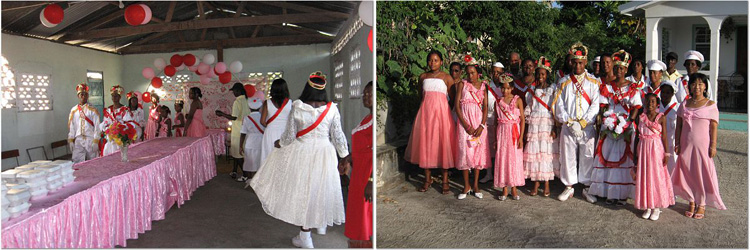
Both societies have a formal hierarchic structure patterned upon the socio-economic structure of colonial society. Each society has a king and a queen, as well as princes, princesses, and man other symbolic legal, military and professional roles, such as judges, policemen, nurses, soldiers.
Preparations for the yearly festivals begin several months before the actual feast day. Each group holds "seances". These consist of all night singing and dancing sessions where drinks are sold and games are played.
The central figure at the "seances" is the shatwel or leadsinger who sustains the spirit and tenor of the entertainment. Most groups have one outstanding shatwel. They are usually female.
On the actual day of the festival all members of the society dress in the finery of their respective roles and march to Church for a service which precedes their parade through the streets before returning to the hall for their feasting or grande fete.
Choiseulstlucia.com wrote a scant report on the two flower festivals.
Their emphasis is more on the La Rose festival and you can't blame them for this since this festival takes precedence over the La Magawit in the district.
Below is the extract from the web page on culture.
The Flower Festivals: La Rose & La Marguerite
St. Lucia has two flower societies that put on festivals each year, La Rose and La Marguerite. They are rival societies that commemorate the Anglo- French heritage of the island; the factions represent the warring colonial powers, between whose hands Saint Lucia changed fourteen times. The societies date back to the early 19th century, when each village was home to competing organizations of the Roman Catholic Church.
Both societies draw on English royalty traditions and have a number of positions, including the King, Queen, Prince, Princess and various lower titles like the Chief of Police and nurse. La Rose and La Marguerite meet once weekly except during Lent. At these meetings, which are on Saturday for La Rose and Sunday for La Marguerite, members sing or play instruments and dance.
La Marguerite meetings feature the membership in a seat chorus with a leader, the chantwèl, standing, while La Rose meetings include instruments like the tanbouwen (tambourine), baha (wooden trumpet), chakchak (rattles), guitar and gwaj (scraper).
The celebrations of both groups differ. La Rose, the "English" faction, is characterized by noisiness, movement, participation, rhythm and exuberance, while La Marguerite, the "French" faction, is characterized by melody, discipline and restraint. There is a vibrant tradition of women singing factional songs related to this rivalry.
Traditions common to both factions include the omans, a sort of waltz, Marches and the duple rhythm manpa (or maynan) dance. Kwadril and lakonmèt are also performed by La Rose.
Fet La Woz Seance Band
Each society holds an annual festival or grand fete, an elaborate and colorful event full of pomp and pageantry, which is preceded by several months of nightly singing practices called “Séances”. Presiding over the annual festivals are the ‘King’ and ‘Queen who are accompanied by their royal entourage of Dukes, Duchesses, Princes, Princesses, Soldiers, Policemen, Magistrates, Doctors, nurses, the clerical hierarchy and supporters of the respective flowers.
Strict protocol is observed at those nightly Séances, with every visitor or participating member, upon entering, bowing to the King and Queen who are present with their court. Police and soldiers in uniform enforce regulations against any disorder, breaches of protocol, or what are considered misdemeanors. Offenders are taken before a magistrate for a mock trial and then fined.
Each society has a patron saint on whose feast day the grand fete is celebrated. For the Roses it is the feast of St. Rose of Lima on the 30th August; and for the Marguerites it is that of St. Margaret Mary Alacocque, 17th October.
The grand fete is celebrated, first with church services throughout the island and afterwards with processions through the streets, the principal personages magnificently attired. In the evening there is a sumptuous banquet to which dignitaries and leading personalities are invited. The rest of the evening is spent in dancing. One can then witness and participate in some of the colorful folk dances, the Quadrille, the Mappa, the Belair and such like.
The first La Rose group in Choiseul was formed in 1939 with Mr. Mc. Vane Antoine (Mr. Po from La Fargue) and Mrs. Janice ‘Ma Miese’ Mitchel as first King and Queen respectively. A few years later saw the birth of the first La Marguerite group. Mr. ‘Dor dor’ Cox (from Dacretin) and Lucien Peter, King and Queen respectively.
Source:The Culture page - http://www.choiseulstlucia.com
The societies originated in the time of slavery as co-operative work groups created for mutual support, and assistance in time of trouble. These groups were similar to the dokpwé of Dahomey, and the coumbite of Haiti.
The two societies are vaguely inspired on two mystic orders that were active at the time in Europe, Rosicrucianism and Freemasonry. This connection is depicted in a mural painted by Dunstan St. Omer, which shows the holy trinity of Osiris, Horus and Isis.
In former years the St Lucian society was split in affiliation to one or the other group. At times membership has been illegal, and it has also been condemned by the Roman Catholic Church. Nevertheless the societies survived, although their nature has changed through the centuries. As the general society changed, so did the sociétés, becoming more commercial and money-oriented. In time, other organisations were created for money saving and social security. Nowadays, the two historical societés are largely devoted to solidarity through recreation.
At the time of Saint Lucia's Independence, when the national symbols – tree, bird, flower etc. – were being defined, St Lucia chose to have two flowers, a rose and a marguerite.
Both societies have a formal hierarchic structure patterned upon the socio-economic structure of colonial society. Each society has a king and a queen, as well as princes, princesses, and man other symbolic legal, military and professional roles, such as judges, policemen, nurses, soldiers.
Preparations for the yearly festivals begin several months before the actual feast day. Each group holds "seances". These consist of all night singing and dancing sessions where drinks are sold and games are played.
The central figure at the "seances" is the shatwel or leadsinger who sustains the spirit and tenor of the entertainment. Most groups have one outstanding shatwel. They are usually female.
On the actual day of the festival all members of the society dress in the finery of their respective roles and march to Church for a service which precedes their parade through the streets before returning to the hall for their feasting or grande fete.
Choiseulstlucia.com wrote a scant report on the two flower festivals.
Their emphasis is more on the La Rose festival and you can't blame them for this since this festival takes precedence over the La Magawit in the district.
Below is the extract from the web page on culture.
The Flower Festivals: La Rose & La Marguerite
St. Lucia has two flower societies that put on festivals each year, La Rose and La Marguerite. They are rival societies that commemorate the Anglo- French heritage of the island; the factions represent the warring colonial powers, between whose hands Saint Lucia changed fourteen times. The societies date back to the early 19th century, when each village was home to competing organizations of the Roman Catholic Church.
Both societies draw on English royalty traditions and have a number of positions, including the King, Queen, Prince, Princess and various lower titles like the Chief of Police and nurse. La Rose and La Marguerite meet once weekly except during Lent. At these meetings, which are on Saturday for La Rose and Sunday for La Marguerite, members sing or play instruments and dance.
La Marguerite meetings feature the membership in a seat chorus with a leader, the chantwèl, standing, while La Rose meetings include instruments like the tanbouwen (tambourine), baha (wooden trumpet), chakchak (rattles), guitar and gwaj (scraper).
The celebrations of both groups differ. La Rose, the "English" faction, is characterized by noisiness, movement, participation, rhythm and exuberance, while La Marguerite, the "French" faction, is characterized by melody, discipline and restraint. There is a vibrant tradition of women singing factional songs related to this rivalry.
Traditions common to both factions include the omans, a sort of waltz, Marches and the duple rhythm manpa (or maynan) dance. Kwadril and lakonmèt are also performed by La Rose.
Fet La Woz Seance Band
Each society holds an annual festival or grand fete, an elaborate and colorful event full of pomp and pageantry, which is preceded by several months of nightly singing practices called “Séances”. Presiding over the annual festivals are the ‘King’ and ‘Queen who are accompanied by their royal entourage of Dukes, Duchesses, Princes, Princesses, Soldiers, Policemen, Magistrates, Doctors, nurses, the clerical hierarchy and supporters of the respective flowers.
Strict protocol is observed at those nightly Séances, with every visitor or participating member, upon entering, bowing to the King and Queen who are present with their court. Police and soldiers in uniform enforce regulations against any disorder, breaches of protocol, or what are considered misdemeanors. Offenders are taken before a magistrate for a mock trial and then fined.
Each society has a patron saint on whose feast day the grand fete is celebrated. For the Roses it is the feast of St. Rose of Lima on the 30th August; and for the Marguerites it is that of St. Margaret Mary Alacocque, 17th October.
The grand fete is celebrated, first with church services throughout the island and afterwards with processions through the streets, the principal personages magnificently attired. In the evening there is a sumptuous banquet to which dignitaries and leading personalities are invited. The rest of the evening is spent in dancing. One can then witness and participate in some of the colorful folk dances, the Quadrille, the Mappa, the Belair and such like.
The first La Rose group in Choiseul was formed in 1939 with Mr. Mc. Vane Antoine (Mr. Po from La Fargue) and Mrs. Janice ‘Ma Miese’ Mitchel as first King and Queen respectively. A few years later saw the birth of the first La Marguerite group. Mr. ‘Dor dor’ Cox (from Dacretin) and Lucien Peter, King and Queen respectively.
Source:The Culture page - http://www.choiseulstlucia.com